The Right Way to Remove a Turmeric Stain From Indian Fabrics
TL;DR
- ·Turmeric stains are dye stains — curcumin bonds chemically to textile fibres and does not respond to standard detergent in the way food stains do
- ·Sunlight is the most effective treatment for turmeric on white and light cotton — UV exposure degrades curcumin through photodegradation
- ·Alkaline pre-treatment helps loosen curcumin on cotton but is damaging to silk and wool
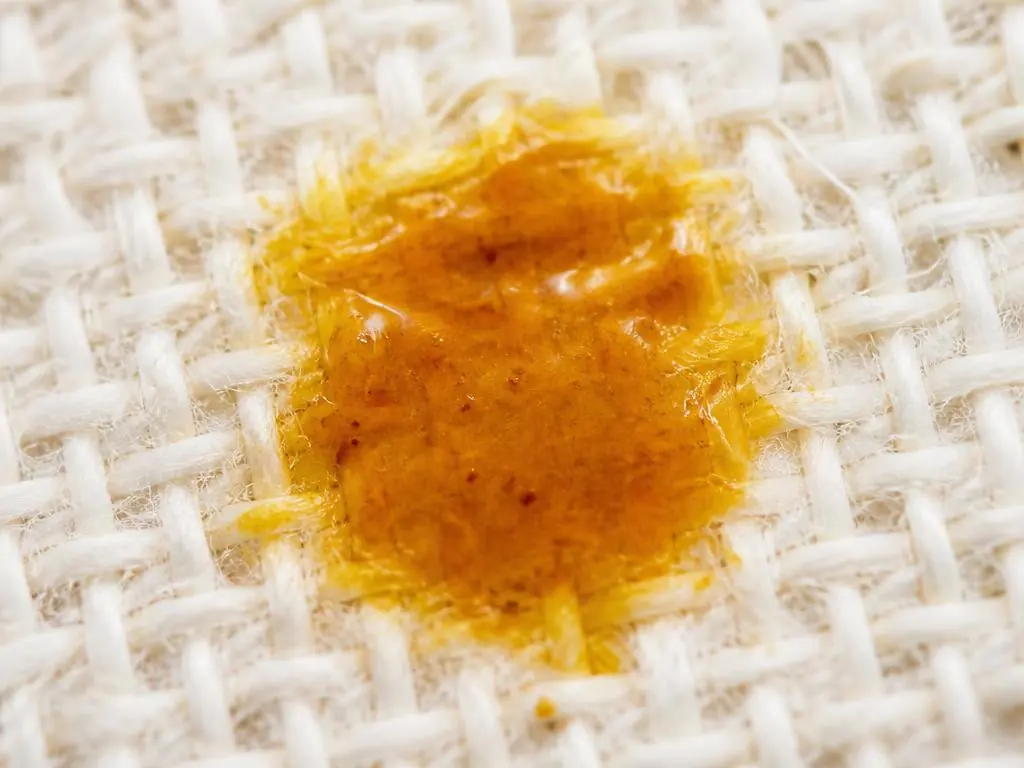
Turmeric — haldi — is in most Indian kitchens every day. It goes into daal, sabzi, rice, marinades, and face packs. It also ends up on clothes, tablecloths, kitchen towels, and the occasional white cotton kurta at the worst possible moment. And unlike most food stains, it does not behave like one. Turmeric is not a food stain in the chemical sense. It is a dye stain. The compound responsible — curcumin — is one of the most effective natural dyes known, capable of binding strongly to textile fibres. Treating it like a food stain with standard detergent and a normal wash cycle will usually disappoint. Understanding what curcumin actually is and how it bonds to fabric changes both the expectation and the approach.
Why Turmeric Is Different From Other Food Stains
Most food stains — oil from a curry, dal residue, tomato gravy — are either oil-based or protein-based substances deposited on fabric. They can be physically removed by surfactants and water because they are not chemically bonded to the fibre.
Curcumin, the yellow-orange pigment in turmeric, is a polyphenolic compound that acts as a natural dye. Natural dyes work by bonding chemically to textile fibres — this is their function. Curcumin has a particularly strong affinity for protein fibres like silk and wool (which is why silk dyed with turmeric takes up colour readily) and a moderate affinity for cellulose fibres like cotton and linen.
Once curcumin bonds to fibre, standard detergent — which works by emulsifying oils and carrying them away — has limited ability to break the chemical bond. The stain may fade slightly with repeated washing, but rarely disappears entirely through detergent action alone.
What Actually Works — By Fabric Type
Cotton and Linen
Cotton and linen are cellulose fibres. Curcumin bonds to them less strongly than to protein fibres, which means more options are available for treatment.
Sunlight is the most effective treatment for turmeric stains on white and light-coloured cotton. Curcumin is photosensitive — it degrades under ultraviolet radiation through a process called photodegradation. After washing the garment normally in cool water, lay it flat in direct, strong sunlight while still damp. The UV exposure will gradually break down the curcumin molecules. This process works best in bright Indian summer sunlight and may require several hours of exposure, or repeat sessions on multiple days for older stains.
This is not a quick fix, but it is a genuinely effective one for cotton and linen that produces no secondary damage to the fabric.
Alkaline pre-treatment can help loosen curcumin on cotton. A brief soak in a dilute solution of baking soda (sodium bicarbonate) — approximately one tablespoon dissolved in a litre of cool water — before the normal wash creates mildly alkaline conditions that disrupt the curcumin-cellulose bond. Rinse thoroughly before the main wash. Do not use this approach on silk or wool where alkaline conditions cause fibre damage.
Oxygen-based bleach (not chlorine bleach) is appropriate for white cotton only. Oxygen bleach oxidises curcumin and can significantly reduce staining on white cotton fabric. Test on an inconspicuous area first. Never use on coloured fabric, silk, or wool.
Silk
Silk is a protein fibre. Curcumin bonds strongly to protein fibres — which is why silk is one of the traditional fabrics used for turmeric dyeing. This means turmeric stains on silk are significantly harder to remove than on cotton.
The constraints on silk treatment are more severe: no alkaline treatment (damages silk), no hot water (damages silk), no oxygen bleach (risks colour and fibre damage), and UV exposure sufficient for photodegradation risks UV damage to the silk itself.
For fresh turmeric stains on silk, rinse immediately in cool water to remove excess turmeric before it bonds. A gentle, pH-neutral silk-safe detergent applied to the stain and rinsed in cool water may reduce the stain. Beyond this, professional fabric care with specialist spotting agents is the most realistic option — and complete removal cannot be guaranteed.
For valuable silk garments — Kanjivaram sarees, Banarasi silk, embroidered occasion wear — any stain treatment should be referred to a professional fabric care service. Attempting aggressive home treatment on valuable silk risks fibre and colour damage that may be more visible than the original stain.
Synthetic Fabrics
Polyester, nylon, and synthetic blends have lower affinity for curcumin than natural fibres. This means turmeric stains on synthetics are typically easier to address. Standard detergent with surfactant pre-treatment (applying liquid detergent directly to the stain before washing) is more effective on synthetics than on cotton or silk.
Avoid high-temperature washes on synthetic fabrics regardless of stain type — heat can cause synthetic fibres to permanently deform.
Timing Is Everything
The most important variable in turmeric stain treatment is time. Fresh turmeric — before the curcumin has fully bonded to the fibre — is significantly easier to address than dried or set turmeric.
For a fresh turmeric stain:
- Remove excess turmeric immediately — scrape or blot, never rub
- Rinse under cool running water from the reverse side of the fabric — this pushes the stain out rather than further in
- Apply a small amount of liquid detergent to the damp stain and allow it to sit for 10 minutes
- Rinse again in cool water
- Wash normally at the appropriate temperature for the fabric
- Air dry in sunlight for cotton and linen
Do not dry in a tumble dryer or place in direct heat before checking whether the stain has been reduced. Heat — whether from a dryer or from ironing — will help set any remaining curcumin.
Managing Expectations
Turmeric is a natural dye that has been used in India for centuries precisely because of its fastness to textile fibres. Complete removal of a dried, set turmeric stain from most fabrics is not reliably achievable through home treatment. What is achievable, particularly on white cotton with sunlight exposure, is significant reduction to the point where the stain is no longer conspicuous.
For coloured or embroidered garments, for silk, and for any garment of sentimental or monetary value, a professional fabric care service with access to specialist stain-removal agents and techniques offers the best realistic outcome.
Key takeaways
- Turmeric stains are dye stains — curcumin bonds chemically to textile fibres and does not respond to standard detergent in the way food stains do
- Sunlight is the most effective treatment for turmeric on white and light cotton — UV exposure degrades curcumin through photodegradation
- Alkaline pre-treatment helps loosen curcumin on cotton but is damaging to silk and wool
- Silk has high affinity for curcumin — turmeric stains on silk are very difficult to remove and should be referred to a professional
- Timing is critical — fresh turmeric treated immediately before bonding is far more removable than dried or heat-set staining
This article is for general educational purposes only. It draws on publicly available research cited above. fabwash.com does not provide medical, dermatological, or professional advice. Consult a qualified professional for health or fabric care concerns specific to your situation. fabwash.com is an independent editorial platform founded by Vestido Fabwash Studio, Bengaluru — see our About page for full founding disclosure.
Sources
- Journal of Natural Fibres — Curcumin Interaction with Textile Fibres: Binding Mechanisms and Photodegradation, Vol. 14, 2017
- Textile Research Journal — Natural Dye Fastness on Cotton, Silk and Synthetic Fibres, Vol. 86, 2016
- American Cleaning Institute — Stain Treatment Guide: Dye-Based Stains, 2021
- International Fabricare Institute — Curcumin Staining in Professional Fabric Care: A Technical Note, 2020
- Bureau of Indian Standards IS 14616 — Textile Care Labelling Code, 2000 (reaffirmed 2018)
Discussion
Comments are moderated. Yours appears once an editor approves it.
Sign in to comment- No comments yet. Be the first to add context.